

Dr. Kimberly Kujinga has been in the business of breaking glass ceilings for a while now. She is arguably one of the most outspoken people you will be lucky to meet in your lifetime. When she speaks, the air leans in and you can almost feel the sharpness of the lingering curiosity. She orates like a compendium. Fluency of language is perhaps a cool thing to be known for, but articulate thoughts are an admirable suit. She owns the surroundings in conversations, holds the parent ground such that when she coyly refers to her talkativeness as exasperating, it immediately feels like a sinful allusion, almost illegal.
Unlike many who refer to their many hats as a clothing charade, Dr. Kimberly believes hers are a stack of impact bricks imparted on her life over the years and she is now an embodiment of a fully emancipated woman, educated and exploring career in new territories:
I was studying medicine at the University of Zimbabwe and remember feeling like I needed to finish medical school, but there was so much missing in what that education offered me. It was heavily technical, medicine-oriented, and less preparatory of what navigating life really looks like. I had a background as a former Interact of Rotary International and was budding with interest in impacting communities.
I joined Rotaract and proceeded to become the first female President in the history of the club. That same year, paNhari had just started the Transformative Leadership Skills Development Training on-campus and I was attracted to the fact that the program prepared young people to catalyze impact in the community through leadership, financial and life skills that one could use in their everyday lives. I was looking for avenues to involve myself in giving back. I applied and did the course through the semester, complimenting it with the impact work I was doing with the Rotaract Club of Zimbabwe and Rotary International. Firsts are inherently challenging, especially for a woman in male-dominated spaces. I struggled with impostor syndrome, scared and doubting whether I would be able to match up to such a huge responsibility. At that small level, I felt like I had the weight of the world on me at the time. It was a struggle at first because I was trying to row the boat on my own. Walking with paNhari through it really helped me shake up my leadership skills. I went the servant way, leading from the back. The training made me realize that I did not have to do it by myself and pushed me to draw from the strengths of my team.
“Being a leader predominantly involves taking a team from point A to B, but it also means recognizing my capacity enough to lean on my team’s strength to achieve greatness.”

During my term, the Rotaract Club was the most decorated in our district, in Africa and got a mention at Rotary International that year. The same year, I got the Vice Chancellor’s Ambassador’s Award, a humbling moment. paNhari gave me the tools that got me there.
paNhari needed a campus coordinator to continue the course on campus as it had picked and many students were expressing growing interest. I applied and paNhari offered me the opportunity to serve in a larger capacity. I believed so much in the vision that I wanted it to cross and transcend universities. The co-founders were quite pivotal because they encouraged me to go for it. We organized leadership and innovation bootcamps, programs that were received well and built them up to field excursions to orient the students to the realities of communities around the school. The learners really appreciated the impact this had on them, and it was also my way of continuing to give back to the community while still learning.
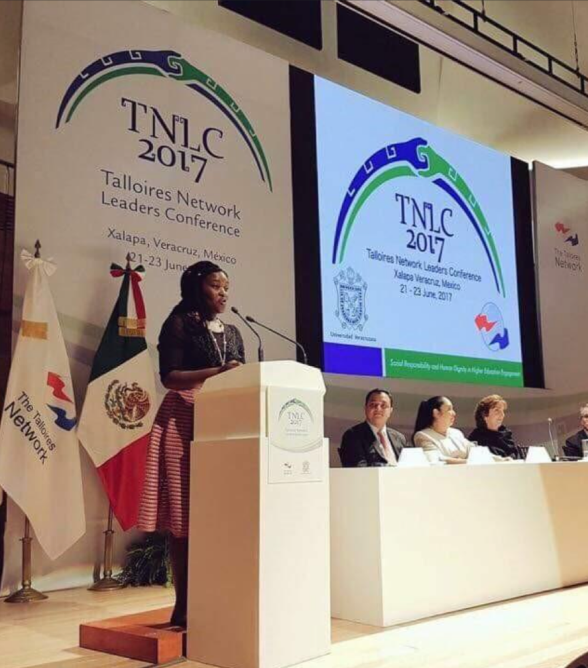
I got selected as a Fellow for the Elephant Initiative, a global youth strategic planning project supported by Mastercard Foundation and attended the Talloires Network Leadership Conferences in Cape Town (2014), and represented paNhari in Xalapa, Mexico (2017) at yet another TN Leadership Conference. I spent months interviewing stakeholders and developing new ideas for higher education.
Through the program, I worked with five other fellows on projects within communities and universities from which feedback helped shape precedent leadership conferences.
Being part of the initiative reminded me of how important it is to recognize that there will always be somebody on step zero and somebody else on step five. For us to collectively progress, we need to bring step zero to step five before we move forward together. Giving people the tools that they needed in their own situation was really important to me and it is a good thing that paNhari prioritized equity by giving young people the support to achieve what they needed to. Everyone thrived regardless of their financial background.
paNhari really helped me grow in my own leadership and opened my eyes to the fact that we have shared problems and challenges as students in different universities across the world. My biggest highlight was learning about being a matriarch in my own space and realizing that I share the same problems as other young people navigating life. Engaging with the Talloires Network’s leadership, going to Tufts, and chatting with other university students inspired me to start my entrepreneurship journey back home. It is something that led me to become more financially independent from an early age despite being a student working towards a definitive pathway.
paNhari, for me, was the coming together of different people from diverse backgrounds doing different projects in communities. The outreach was quite extensive, and the kind of peer mentorship at our own youth level was completely different. It is so easy for people who have achieved everything to come down and say, “you can do this and that” but then if you are a small person in the big pond, it is hard to believe it. When you see another young leader doing it, it makes things a bit more tangible. The mentorship model made success believable to young people. paNhari completely changed my life. I had people mentor me, taking me from one stage to another, made me believe that I am stronger than I think I am and that I deserve a seat at the table. The presence of an avenue that enabled and validated my ambitions did a lot to my self-confidence. It prepared me to have self-confidence by acknowledging the fact that we can also be voices as women and pushed us to the responsibility of charting pathways for other young women and girls. It is for the same that reason that I continue to minister to young women back home to take leadership space. I call it my big sister program.
I just started my medical training, specializing in Australia and I remember being scared at the beginning. My experience at paNhari has however translated into this new system and being able to use the skills I learnt back then at a personal level is truly profound.
In medicine, I inevitably deal with people every day and now I can show up with more empathy and interest in the factors that surround their medical conditions.
I have been promoted three times at my job, in two years, because of the leadership development skills I learnt; of not giving up, not being quiet and showing up diligently. We were taught that when you do something, do it to the best of your ability and your work ethic will precede you. I started a new role a few weeks ago, and I see myself drawing upon the lessons and skills I learnt from being a campus coordinator.
I also recently started a support group for other medics looking to move to Australia. I remember struggling through the immigration process, with little available help, and I want to rewrite and ease the transition for others.